


Views: 0
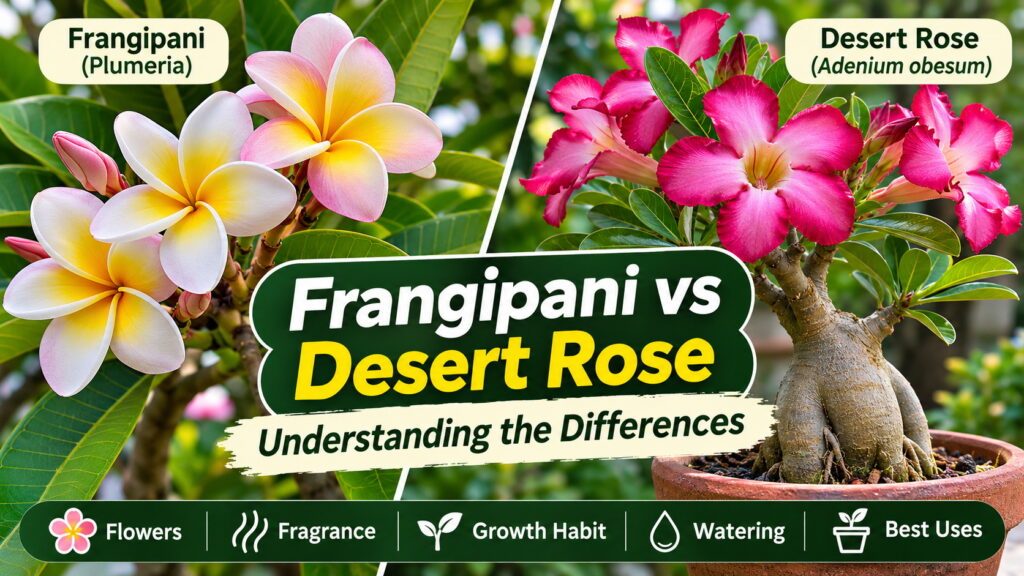
Frangipani vs Desert Rose: Understanding the Differences
Frangipani and Desert Rose are two beautiful flowering plants commonly grown in warm climates. Both produce colorful flowers and bring an exotic appearance to gardens, patios, and balconies. However, they differ in their growth habits, trunk structure, fragrance, and watering requirements.
Although both belong to the Apocynaceae plant family, they are distinct plants. Understanding their differences can help gardeners choose the most suitable species for their growing conditions.


1. What Is Frangipani?
Frangipani is the common name for plants belonging to the genus Plumeria. These flowering trees and shrubs are native to tropical regions of the Americas and are widely cultivated in warm countries.
Frangipani is particularly valued for its fragrant flowers, which may be white, yellow, pink, red, or combinations of these colors. Many varieties produce a pleasant fragrance that becomes especially noticeable during warm evenings.
The plant normally develops thick branches, elongated green leaves, and a spreading canopy. Depending on the species, climate, and growing conditions, mature plants can become small ornamental trees.
Main Characteristics of Frangipani
- Scientific name: Plumeria species.
- Plant type: Flowering tree or shrub.
- Growth: Often reaches several meters in height.
- Flowers: Usually fragrant, with five overlapping petals.
- Leaves: Long, broad, and grouped near branch tips.
- Sunlight: Prefers full sun.
- Water: Moderate during active growth, reduced during dormancy.
2. What Is Desert Rose?
Desert Rose, scientifically known as Adenium obesum, is a succulent shrub native to parts of Africa and the Arabian Peninsula.
Unlike Frangipani, Desert Rose has a swollen trunk base called a caudex. This structure stores water and helps the plant tolerate periods of drought.
Desert Rose is especially popular among gardeners who enjoy growing ornamental plants in containers. Its colorful flowers and sculptural trunk make it a distinctive decorative specimen.


Main Characteristics of Desert Rose
- Scientific name: Adenium obesum.
- Plant type: Succulent flowering shrub.
- Growth: Usually compact in containers, although mature outdoor plants can become much larger.
- Flowers: Trumpet-shaped, commonly pink, red, or white.
- Trunk: Swollen caudex that stores water.
- Sunlight: Requires bright light and generally benefits from direct sun.
- Water: Needs well-draining soil and careful watering.
3. Frangipani vs Desert Rose: Comparison Table
| Feature | Frangipani | Desert Rose |
|---|---|---|
| Scientific name | Plumeria spp. | Adenium obesum |
| Growth form | Tree or shrub | Succulent shrub |
| Trunk | Woody, thick branches | Swollen, water-storing caudex |
| Flower fragrance | Often strong | Usually weak or absent |
| Water needs | Moderate when growing | Low to moderate |
| Garden use | Courtyards and landscapes | Pots and rock gardens |
| Propagation | Mainly cuttings | Seeds, cuttings, grafting |
4. Differences in Flowers
Both plants are admired for their flowers, but their appearance and fragrance differ.
Frangipani Flowers
Frangipani flowers usually have five overlapping, rounded petals that form an elegant spiral. Their colors range from soft white and yellow to rich pink and red.
Many varieties release a sweet fragrance that makes them suitable for tropical-style gardens and outdoor seating areas.


Desert Rose Flowers
Desert Rose flowers typically have a trumpet-shaped structure with five spreading lobes. Cultivated varieties may display striking combinations of pink, red, white, and contrasting flower centers.
Some modern varieties also produce double flowers with additional petals. Unlike Frangipani, most Desert Rose flowers have little noticeable fragrance.


5. Differences in Trunk and Leaves
One of the easiest ways to distinguish Frangipani from Desert Rose is to examine their trunks.
Frangipani: Develops a woody, branching structure with relatively thick stems. The foliage is usually concentrated near the ends of branches, forming a broad canopy as the plant matures.
Desert Rose: Develops a thickened, swollen trunk base called a caudex. This water-storage adaptation gives the plant its characteristic sculptural appearance.
Although both plants may lose leaves during unfavorable conditions or dormancy, Desert Rose is especially adapted to dry environments.
6. Sunlight and Temperature Requirements
Both Frangipani and Desert Rose prefer warm temperatures and bright growing conditions.
Frangipani
- Best flowering generally occurs in full sunlight.
- Warm conditions encourage healthy growth.
- Cold weather can cause leaf loss and dormancy.
- Protect young or recently transplanted plants from extreme heat until established.
Desert Rose
- Requires bright light and several hours of sunshine for reliable flowering.
- Thrives in warm climates when roots are well-drained.
- Container plants may benefit from some afternoon protection during exceptionally hot weather.
- Cold and prolonged wet conditions can cause serious root problems.
7. Watering and Soil Differences
Water management is particularly important when growing these two plants.
Watering Frangipani
Frangipani needs regular but controlled watering during periods of active growth. Allow the upper soil to dry between waterings, and avoid keeping the roots permanently saturated.
When the plant becomes dormant and sheds its leaves, reduce watering significantly.
Watering Desert Rose
Desert Rose stores water in its thick stem and therefore tolerates dry periods relatively well. Its roots are sensitive to prolonged moisture, making excellent drainage essential.
Use a porous potting mixture containing suitable mineral components such as pumice, perlite, or coarse horticultural grit. Water thoroughly during active growth, then allow the growing medium to dry before watering again.
Important: Neither plant should be grown in permanently waterlogged soil.
8. Which Plant Is Better for UAE Gardens?
Both plants can perform well in the United Arab Emirates, including Abu Dhabi and Dubai, when grown in suitable conditions.
Frangipani is particularly suitable for villa gardens, courtyards, and landscaped areas where there is enough room for a small flowering tree.
Desert Rose is an excellent choice for balconies, terraces, sunny patios, and decorative containers. Its compact growth and unusual trunk make it particularly attractive as a specimen plant.
During the hottest summer periods, container plants may require more frequent inspection because their potting mixes can dry rapidly and their roots may overheat.
Although Desert Rose tolerates drought, this does not mean it should remain completely without water during active summer growth.
9. Propagation: How to Grow New Plants
Frangipani Propagation
Frangipani is commonly propagated through mature stem cuttings.
- Select a healthy branch from an established plant.
- Cut it using a clean, sharp tool.
- Allow the cut end to dry and callus in a sheltered location.
- Plant the cutting in a well-draining growing medium.
- Keep it warm and avoid excessive moisture while roots develop.
Desert Rose Propagation
Desert Rose can be propagated from seeds, cuttings, or grafting.
Growing from seed is often preferred when the objective is to develop a naturally enlarged caudex. Cuttings can produce flowering plants, but they may not develop the same swollen trunk structure as seed-grown specimens.
Grafting is also widely used to reproduce desirable flower colors and cultivated varieties.
10. Safety and Common Growing Problems
Both Frangipani and Desert Rose contain milky latex sap. The sap may irritate the skin or eyes, and plant material should not be ingested.
Desert Rose is particularly poisonous if swallowed. Keep both plants away from children and pets that may chew on leaves, stems, or flowers.
Common growing problems include:
- Yellowing leaves: May result from dormancy, watering problems, or environmental stress.
- Root rot: Usually associated with poor drainage and excessive moisture.
- Limited flowering: May result from insufficient sunlight, immature growth, or unsuitable care.
- Leaf pests: Spider mites, mealybugs, and other sap-feeding insects can affect both plants.
11. Frangipani or Desert Rose: Which Should You Choose?
Choose Frangipani if you want a fragrant ornamental tree that provides a tropical atmosphere, beautiful seasonal flowers, and a broad branching structure.
Choose Desert Rose if you prefer a compact plant with colorful flowers, a distinctive swollen trunk, and attractive container-growing potential.
For larger gardens, combining both plants can create a visually interesting landscape with contrasting growth forms and flower displays.
Conclusion
Frangipani and Desert Rose are related flowering plants, but they are not interchangeable. Frangipani is generally larger and better known for its fragrant flowers, while Desert Rose is admired for its drought adaptations, colorful blooms, and sculptural caudex.
Both can thrive in warm climates with good sunlight, suitable soil, and careful watering. The best choice depends on the gardener’s available space, preferred appearance, and willingness to manage each plant’s individual care requirements.